
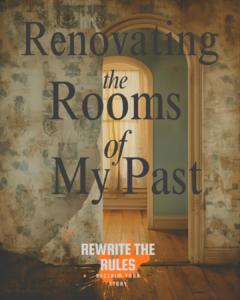
Publishing my book was never just about completing a manuscript. It meant me having to sift through a lifetime of memories, gathering pieces of myself I’d left scattered along the way. In many ways, the writing became a map leading me back to places within myself I hadn’t visited in years.
I had to walk through the corridors of my past and reopen doors I’d closed long ago. And I won’t pretend it was easy; some of those doors were heavy and fuckers to reopen, some were like they were stuck in their frames trying to shield me from whatever waited on the other side.
Going through this process took me six long years, but it didn’t just result in me completing the book; it changed me in ways I never could have anticipated. So, in today’s blog, I want to take you on my journey to help give you an insight as to what changed and offer some prompts in the form of a short workbook that might give you the courage to do the same.
Imagine this:
Imagine I’m a house and every bit of my past life/lived experiences were tucked away, hidden behind doors in rooms inside of me
Some rooms I used to visit often, they were ok, they felt familiar, warm, lived‑in. Then there were some others I could march past sharpish, pretending I hadn’t clocked the handle that would allow me to open them. And then there are the rooms I had forgotten existed, sealed off by time, that was until writing forced me to pause, jiggle the handle, and step inside once more.
Most of the rooms that I resisted revisiting were cluttered, places where I’d shoved all the emotional junk that I didn’t want to deal with. Beliefs that no longer fit me but that I kept anyway, like the size ten jeans, I thought I might wear again someday, but knew deep down that I never would.
Then there were the painful memories wrapped in old blankets and pushed into corners, and my dreams stacked on shelves, waiting patiently for the version of me who once promised she’d come back for them “one day.”
Some rooms are dimly lit, their windows covered, the air thick with stories I never finished telling myself. Stories I abandoned halfway through because they were too heavy or too confusing to sit with at the time.
And then there are the sentimental cupboards. Tiny spaces crammed with objects that served no purpose except the emotional weight I’ve attached to them. Old narratives. Old identities. Old versions of me I’ve outgrown but still feel strangely loyal to. But the house didn’t end there.
Climbing Into the Attic: The Stories I Inherited
Every house has one, or a loft, it’s where we store the things we didn’t choose but somehow ended up carrying anyway.
Up there were the stories I inherited long before I found the language to question them. Family beliefs. Cultural expectations. Patterns passed down like heirlooms. Some were wrapped carefully, as if they were precious. Others were shoved into boxes with no labels, humming with emotions that weren’t entirely mine.
Opening some of those boxes was confronting. I had to ask myself: Is this belief mine, or did I inherit it? Is this fear something I lived, or something I learned?
But after I finished in the attic, it helped me understand and accept that not everything handed down deserves to be held on to, and I was able to let it all go.
Descending Into the Basement: The Things I Buried Deep
If the attic held what I had inherited, well then, the basement held what I buried.
Walking down there felt different. The air was cooler, heavier. The light didn’t reach as easily. This was where I had stored the things I didn’t want anyone to see, including myself. The shame. The grief. The moments I sealed in boxes because I thought ignoring them would make them disappear. – But basements don’t forget. They wait.
Writing my memoir forced me to turn on the light and face what I had hidden. Not to relive the pain, but to reclaim the parts of me I had abandoned down there. And strangely, once I opened those boxes, the monsters I’d imagined were far smaller than the shadows they cast over me for years.
The Work of Sorting, Cleaning, and Letting Go
My metaphorical task in writing the memoir was to walk into each room with honesty and courage. To pick up every object, every memory, every belief, every wound, and ask myself whether it still belonged in my life.
- Some things I kept.
- Some I released.
- Some I cleaned gently with compassion, wiping away the dust so I could see them clearly for the first time.
Only when a room felt understood and reorganised could I close the door with peace, knowing that if I ever returned, I wouldn’t be walking back into chaos but into clarity.
Though There Were Some Doors That Were Harder to Open Than Others
Some doors opened effortlessly. Others creaked with resistance. A few were locked so tightly I had to search within myself for the courage to first find and then use the key to open them.
There were many a moment when I stood before some doors, with my heart pounding, afraid of what might be waiting behind them.
But I kept going. Each day, I kept turning up, even on the days I didn’t fancy it. because deep down, I knew nothing in those rooms could physically hurt me anymore. And I also knew that if I was going to finish what I’d started, I had to be straight-up honest and brave about it, because writing a memoir doesn’t let you hide; it demands both.
Discovering Hidden Rooms Within Myself
But the most beautiful part of this journey was discovering rooms I never knew existed.
- Hidden spaces filled with light.
- Rooms overflowing with hope, faith, ambition, compassion, potential and treasures I had forgotten were mine.
- It felt like finding a secret wing of my own house, untouched and waiting for me to claim it.
All of these rooms reminded me that my healing wasn’t just about confronting the past; it was about rediscovering the parts of myself that were never lost, only waiting and as I moved through each room, attic, basement, cupboards, corridors, I started to realise something unexpected: I wasn’t just cleaning the house. I was renovating it.
The walls I once leaned on no longer made sense. Some needed to come down. Others needed reinforcing. I started adding windows to rooms that needed more light. I repainted beliefs that had faded. I rearranged the furniture of my identity until the space finally felt like somewhere I wanted to live.
The Room That Became My Sanctuary
And then there was one room that became my sanctuary, my safe space, a space I now go to every morning before the world awakes, a room untouched by the noise of the outside world, a room where only I have the key.
Inside it, there are just two things: My notebook and my pen, AKA my therapeutic wand.
In this room
- I can prepare myself for the day ahead.
- I can sit with the issues that trouble me and gently unravel them.
- I can set my intentions and choose how I want to show up.
- I can sit with my emotions without interruption.
- I can create.
- I can dream.
- I can write my to-do list and return the next day to celebrate what I’ve achieved.
This room became the place where I can remind myself of who I am and, more importantly, who I’m becoming and it’s a place I visit every morning.
This room is my inner sanctuary and has been the greatest gift of this writing journey. It has taught me that healing isn’t about forgetting the past; it’s about organising it, honouring it, and making space for who you are becoming.
Writing my memoir didn’t just tell my story. It helped me rewrite the way I want to live it.
Ps, if you fancy doing a spring clean of your own house, I have put together a worksheet that will help you. You can find it House Renovation Exercise
Love Tracey
#UnapologeticWriter
Remember – I don’t write for financial reward or gain. I want to help share my lived experience with others, hoping it helps. Plus, I love to write, so if you fancy getting the occasional email (NO SPAM) with the most up-to-date blogs from yours truly, please feel free to subscribe at the bottom of the main page.
I really felt this, Tracy. I’m still in my own healing process and it’s definitely a big journey. The way you talk about those rooms — the ones that open easily, the ones that creak, and the ones you need courage to unlock — honestly gives me hope. It reminds me that the things I’m scared to face aren’t actually as big as the shadows they’ve cast over me.
Your blogs help me see that healing isn’t about pretending the past didn’t happen, but about sorting through it, like you said — keeping some things, letting others go, and gently cleaning the parts of myself I’d forgotten about. I’ve not got your book yet, but it’s on my list because your writing already gives me tools and a bit of light at the end of the tunnel.
Thank you for sharing this. It makes me believe I can walk back into places that once felt heavy and come out stronger on the other side.
Awe thank you for reading chuck x
That resonates with a lot of my self discovery and my inner healing and growth work. I think reflecting on my guidance and past lessons so be patterned into my self discovery. I’m applying a lot to my poetry to research from and provide a humanistic memory. I currently put together some poetry concepts around elderly care to provide motivation for others. I have a poetry collection called the House that Takes me Back to South London based around my teacher in London at Kensington Avenue School her family and the importance learning to be more person centered. Also a Irish man Who I helped and his house connections and people have motivated to find my free Gaza poetry voice and research materialism around my Hippy Values and Principles reaserch and poetry. One of the poems is called the way my trainers bless my Soul. very interesting