This week, I had the privilege of spending time with some of the most inspiring women I’ve met yet. I didn’t know their stories before walking into that room, and they didn’t know mine. The workshop had been organised by Homewards. In the weeks beforehand, I’d met with the staff team from the women’s hostel to understand what they felt might genuinely support the women, given their lived experiences and the challenges they were navigating.
We agreed the session needed to be informal and light-hearted, but also meaningful, so that meant no PowerPoints, no lectures. Just a chance to have an open, honest conversation.
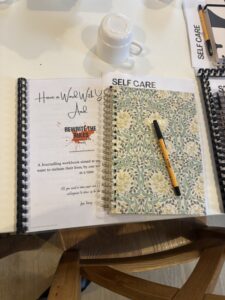
When I arrived, the staff had already set the tone beautifully. They’d bought A5 journals for each woman and printed copies of my Have a Word With Yourself workbook. I’d brought gifts, like one of my therapeutic wands [pen], bookmarks, and a couple of copies of my memoir to add to their library. Beth, one of the staff members, had laid out coloured pens. On a side table sat a cake stand filled with biscuits, sweets, fruit, fresh coffee, and warm croissants. The room looked great, felt welcoming, safe, and intentional.
Six Women, Six Journeys
Eight women had originally signed up, but six arrived, and that was more than enough. The only information that they had been given about the session was that this woman, called Tracey Ford, an author, was coming over from Sheffield to spend some time with them to talk about the benefits of journaling. Each of the women walked in differently, each carrying their own history:
- The first woman through the door lit up when she saw the journals; she was an avid journaler herself, and we bonded instantly over our shared admiration for Dr Joe Dispenza.
- Another woman arrived beaming, full of banter, but later revealed in the session that humour was her coping strategy.
- Another was recovering from surgery after having sixteen teeth removed, the result of a broken jaw years earlier. Her pain and anxiety were visible, not just from the operation but also from the weight of her own past trauma.
- Another walked in with a quiet pride, she was eighteen days into detox after years of substance misuse and said that the workshop had peaked her interest because she’d always wanted to write her own memoir, but didn’t have a clue where to start [I already know from her personality, her use of sarcastic banter that I want to be one of the first people to read it].
- Another lady barely spoke, but her body language spoke volumes when she offered the occasional knowing nod and smile.
- The last to arrive ten minutes late, but that was ok because the day wasn’t about me and my time session plan. She was the youngest of them all. As she sat down, she confessed she’d been looking forward to the session after she’d recently started therapy and was keen to learn more about herself.
Kicking off the Aims of the Session
Which was simple: to bring everyone together for an honest conversation, to bounce ideas around, and to explore the barriers that stop us from making ourselves a priority. How I wanted them to start practising to capture those thoughts on paper so they could start recognising the patterns that hold them back.
I reassured them that the writing exercises were nothing formal or school-like. That I wasn’t about to walk around with a red pen or mark anyone’s work. I reassured them that everything written in their notebooks was private and for their eyes only, unless they chose to share. And if they didn’t want to, that was completely fine too.
I also mentioned the optional weekly online accountability sessions for anyone who wants continued support on their journey. No pressure, no expectations — just an open invitation for those who feel it would help them keep moving forward.
Some shared that they had come out of curiosity. Some weren’t sure journaling would “work,” which I totally understood, because had someone said to my younger self, I would have thought the exact same.
But in my eyes, the fact that they were willing to try. That alone was a win.
I decided to share my own vulnerability, confessing that I hadn’t slept, that I was nervous, that I was winging it just as much as they were, which I think went a long way to softened the unspoken anxiety in the room, it also helped reinforce to them that we were all equals, but, most of all, that we were all human.
Starting With Breath
The breathing exercise was designed to help everyone settle their nervous systems before moving into their first writing task. Most of the women joined in easily, but one participant struggled; she kept her eyes open and gestured to me that the breathing made her feel nauseous. I reassured her that it was completely fine, I just appreciated that she was willing to try.
When we moved into the writing exercise, a few women hesitated, almost as if they’d forgotten how to use a pen. I knew instinctively that this wasn’t about ability; it was fear. Fear of getting it wrong, fear of making a mistake. So once again, I reminded them that the goal wasn’t perfection; it was simply learning to put feelings and experiences onto the page.
The same woman who struggled with breathing also found the writing difficult. She wrote a few lines, then stopped, head in hands, admitting she found writing hard. I reassured her again, and to my surprise, she picked the pen back up and continued. It was only a couple of lines, but a meaningful step.
I opened the floor for feedback, and when I came to the lady who had previously struggled, her entire demeanour shifted. Her eyes filled with tears, catching all of us off guard. The room fell silent, giving her space. Then she smiled through the emotion and explained they were happy tears. She shared how the exercise had transported her back to memories of her late father, a reflexologist who always reminded her to slow down and be gentle with herself — the very message woven through the exercises we’d just done.
This was the first of many exercises that I had planned for the day, but in that moment, it also reminded me how important it is to create conditions where people feel safe enough to be vulnerable and also that no amount of preparation can help me predict what might surface for participants, especially when you don’t know their histories or past traumas. But what’s within my control is the environment I create for them, and that’s one where they feel supported, seen, and able to move at their own pace.
My role wasn’t to push or fix, but to guide them gently as they explore their own stories through the simple, grounding act of putting pen to paper, reaffirming that having a Word with yourself isn’t about perfection; it’s about offering a safe space for practice, expression, and self-discovery.
Understanding What Holds Us Back
Next, we moved on to exploring the self, our patterns, our beliefs, and our nervous systems and how they are all connected. I talked to them about how most of us operate on old, ingrained patterns, limiting beliefs and assumptions we never chose but somehow inherited and how these limiting beliefs and assumptions run silently in the background, shaping how we think, feel, and react.
I used the analogy of a water leak: you can’t fix it until you find the source, and journaling is just one way to locate that source, gently and safely. To do that, we need to slow down. Create space. Make room for ourselves.
Good Days, Bad Days, and the Patterns in Between
The next exercise was simple but revealing:
- What does a good day look like for you?
- What does a bad day look like?
- What throws you off?
- What thoughts show up first thing in the morning?
This was a powerful exercise; when they came to feed back to the group, something shifted. Seeing their own words reflected back at them in ink had helped them notice things they’d overlooked. Wins they’d achieved. Progress they’d made. Strengths they’d forgotten they had.
Instead of focusing on failures, they had been able to recognise victories, including the small, quiet, powerful victories. I reminded them: despite everything they’d been through, that the fact that they were still here. Still breathing. Still trying. Still showing up for themselves is extraordinary in itself.
The Moment Everything Landed
Then went deeper. I asked them to write about a moment they handled better than they would have in the past.
- What helped them through it?
- What qualities did they show?
- How often did they give themselves credit?
Halfway through, one woman stood up in tears and left the room, again catching us all off guard, and another woman offered to check on her. Once again, the responsibility for being the person who might have caused this distress weighed on me, another reminder about how sensitive and powerful this work is. When they both returned, the lady explained they had been happy tears, she’d just realised she’d achieved something huge recently and writing it down was overwhelming but in a good way, evidence of how far she had grown.
That moment will stay with me for a long time.
Closing With Connection
To close the workshop, I gave each woman slips of paper and an envelope with her name on it. They were asked to write something kind, something they’d learned, or a wish for each of the other women in the room. The envelopes were theirs to take away and open at their own time, as were the project-provided journals. Then I asked them to complete a feedback form. It was only when I got the chance to read some of the feedback that it hit me just how powerful that day had been. One of the main objectives was to use journaling as a personal development tool, something that they can turn to as a healthy coping strategy and judging by their feedback, that objective had been met.
- I learned to listen to myself and that there is always room for change
- Learned how to manage sitting with other women and new ways to cope with my grief, and that I could sit and concentrate for the whole session
- That I can do it, that I will do it, that I can turn my life around to become a better version of myself, also learned that I do still feel things, and I haven’t completely shut down
- I have the ability to express what’s in my head and heart onto paper, how I can really dive deep into the past and tune into how that has impacted who I am today and that I am a little more vulnerable than I thought
- I never understood what journaling was and how beneficial it can actually be
- We are not what other people think of us or what we have come from. There is no correct way to do this whole recovery thing, and that winging it in our own way is ok, also realised I can do whatever I put my mind to
- Been kind to each other’s situations and to myself, and how far I have come in my journey and how proud I am of myself
And Here Is What I Learned
I walked into that room exhausted, unsure, and doubting myself. I walked out, reminded of why this work matters.
I was reminded that:
- Progress often looks like simply showing up.
- People don’t need perfection; they need presence.
- That our own vulnerability builds trust faster than expertise ever will.
- Healing doesn’t happen in grand gestures; it happens in small, brave moments.
And the biggest one was sometimes, the people we think we’re there to help end up teaching us the most. Those six women gave me more than they know. They reminded me that even in the hardest chapters of life, there is resilience, humour, courage, and hope, and some of the memories of that workshop will stay with me for a lifetime.
So thank you, ladies
Love Tracey
#UnapologeticWriter
Remember – I don’t write for financial reward or gain. I want to help share my lived experience with others, hoping it helps. Plus, I love to write, so if you fancy getting the occasional email (NO SPAM) with the most up-to-date blogs from yours truly, please feel free to subscribe at the bottom of the main page.
The Clarity I received from one session has been amazing I am so thankful
Ahhh thank you, I cannot wait to see you at the next online sessions
Love T x