
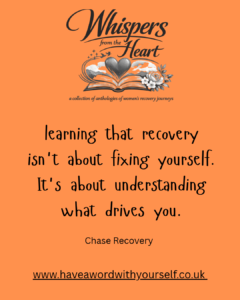
Today I had the absolute privilege of spending a few hours virtually with a group of women who had never met me before, apart from the amazing Cara Cox, performer extraordinaire the lead singer of the Detox Factor, who as well as performing at various recovery events, they also went on to win this year’s 2026 Recovery Street Film Festival with their short film called ‘Game Over’
After some informal introductions, background into the new book that Mulka and I are working on ‘Whispers from The Heart’ I introduced a 10-minute writing exercise and then opened the floor for women to share what they had written and despite not knowing any of them prior to the session, by the end of it, I personally felt connected to every single one of them.
The only fly in the ointment about this morning’s session was that age old familiar chorus that appeared before many of the women started reading out their words
“I might not have done this right.”
“Mine’s a bit different.”
“Sorry, this probably isn’t what you wanted.”
Honestly, every time they voiced their concerns, it made me want to reach through the screen and gently shake every single one of them.
Because the reality is that there is no right or wrong way to do this thing, we call life and there is certainly no right or wrong way to write about it. But what saddens me the most, is how many women, [and men for that matter] are still measuring their self-worth against what they think other people think of them, those ingrained limiting beliefs that whisper we’re not clever enough, good enough, strong enough or worthy enough.
That’s why I believe that taking time out to have a word with yourself is so xxcking important.
During the session I explained to the women why journalling/writing has become so important to me and my recovery. Me putting pen to paper is about far more than writing words, it about creating some space and giving myself permissions to slow down long enough to listen into what I am thinking and feeling. It’s about creating a space where the external noise, demands of my endless to do lists can quieten for a moment, so I can start digging beneath the surface of my conscious thoughts and feelings, to tune into the unconscious side of myself that’s often operating in the background, calling the shots. My unconscious mind is like having my own personal puppeteer master that dictates, my view of the world, based on my past lived experiences, but it is also the same one that prevents me from being my authentic self, and has the ability to instil enough fear that persuades me to avoid change, or take new risks at any cost.
I’ve previously tried to explain this by asking people to try to imagine that their unconscious mind is like the engine of a car.
When they are driving the car, most of their attention is on the steering wheel, the road, and where they are heading. That’s their conscious mind in control, the part making deliberate decisions. But underneath the bonnet, the engine is the unconscious mind who is doing most of the work.
It’s constantly running processes you don’t have time to think about, like generating power, keeping everything moving, but the power generating this is their pre-programmed unconsciousness, powered by old limiting beliefs, unhealed trauma, fear, shame and all the survival strategies that had been sat hiding beneath the surface, [or bonnet] quietly influencing where they went go and how they had got there. pretty much like what addiction is? Addiction is doing something you think you cannot stop and you continue even though your know its not good for you and you still feel powerless to stop!
Thats where journalling, taking time time out for ourselves is not just important its imperative, because if we dont know whats driving us under the bonnet, we are all going to continue driving around in old feedback loops.
These women just like I had done, had spent their lives gripping the steering wheel tighter, trying to control their behaviour, until they had come to realise that the real issue was under the bonnet of their car all along.
There were eleven women in the room and whilst it was clear that each one of them had travelled to similar destinations, taken different routes each one of them had finally found the courage to get their arse out of the driving seat and take a proper look under the bonnet of their car and had come to understand that recovery wasn’t just about changing direction, but about exploring the unconscious mind that’s powering the engine.
And that’s where Chase’s Women’s Recovery Group came in. For many of them, turning up each week was a bit like taking their car into the garage. Not because someone else was going to fix it for them, but because it gives them the space, support and tools to understand it, repair it and keep it running on their own terms.
During the writing exercise, some had wrote narratives, some wrote poems, and some wrote letters. All of them were deeply personal reflections on their own recovery, resilience and rediscovering themselves, and all of the feedback below demonstrated what they had come to learn about themselves.
One woman described herself as once being energetic, ambitious and full of dreams. She had spent ten years living overseas, but somewhere along the way alcohol had crept in until she was drinking two bottles of wine a day. Just four weeks into the programme, she spoke about how the women’s group was already helping her reconnect with her worth.
Another reflected on nearly dying twice. Rather than focusing on the trauma of those experiences, she spoke about gratitude. Gratitude for recovery. Gratitude for friendship. Gratitude for the family she had found through fellowships and others in her recovery community. She described being grateful to be an addict because recovery had introduced her to some of the most genuine relationships she had ever known.
There were stories about angels too, not winged creatures from heaven, but ordinary people who had appeared at extraordinary moments, those that I have talked about myself, the ones who saw something in me that I couldn’t see in myself, those that let me borrow some of their faith until i could find my own.
One woman’s first angel was the stranger who answered the phone when she rang AA late one night in desperation. Another angel later opened a door to community theatre. Other angels came in the shape of women from recovery groups who cheered her on and helped them grow.
Some stories carried unimaginable loss. One woman described a journey that took her from social drinking to daily drinking and eventually hourly drinking. Along the way she lost family, lost herself, lost her children and almost lost her life. Hospitalised with alcohol-related pancreatitis and given just twenty-four hours to live, she somehow found her way back. She described that there had been relapses, prison and setbacks, but there was also determination and as a result of her journey today she has her children back and, perhaps more importantly, she has found peace.
Another woman spoke about finding her mother after an overdose as a child and then attempting to recreate that overdose herself in her teens. Years later, she was sat in a women’s refuge with her son, battling alcohol use and self-harm, but how during that time she experienced a simple but powerful realisation, she didn’t want her ex to win, and at the time of sharing she was seventy-one days sober
Another woman read aloud a letter she had composed to an abusive former partner. She spoke of losing her dad, her home, her job, her car and almost her life. Yet what stayed with me wasn’t the loss she talked about, It was her ending. When she described herself as a small bud beginning to grow and wrote: “The best thing is I’m starting to realise I like who she is.” Those words landed like a punch to the chest, another reminder that recovery is not just about stopping drinking or using, it’s about coming home to yourself.
Another woman talked about a decade spent using alcohol to cope with grief, disappointment and trauma before recognising that what had once felt like a solution had just become another problem to solve.
One shared how, after divorce and years of unhealthy relationships, she finally asked herself what alcohol had been giving her and her answer was “It made me feel warm in my tummy.” That warmth, she realised in that moment was the love she had been searching for all along.
There was poetry too, one woman shared a piece called Gift of Desperation, describing tears in blazing sunshine, saying goodbye to despair and reaching towards others who understand the loneliness addiction can create.
Another described reaching a point where tablets were laid out on a coffee table and how when she glanced at her reflection she no longer recognised the person staring back from the mirror and how in that moment a voice appeared. “There has to be another way.” And for the first time she asked for help and meant it and how now she is studying at university.
The final share came from Cara who had written about having a wobble, more than four years into recovery. A stark reminder that recovery doesn’t suddenly become easy because you’ve got a few years under your belt. She shared how a simple phone call had interrupted a dangerous moment, where she felt unexplainably isolated, but that call had broken the spell and reminded her that she wasn’t alone. Six and a half years into her recovery, she still relies on the same things that have always mattered and those things are connection, honesty and being around other women who understand.
More proof /evidence that recovery isn’t simply about what we stop doing, it’s about what becomes possible, if we dare to believe.
What struck me most wasn’t the trauma, although there was plenty of that. It wasn’t the prison sentence, the overdoses, the abusive relationships, the children taken into care, the relapses, the grief, the heartbreak or the despair. What struck me was the strength, because every single woman who spoke could have given me a hundred reasons why she shouldn’t be where she was today. And yet there they were, still showing up, still supporting one another, still speaking their own truth, truths that many people spend their entire lives running from.
Every single woman in that room had at different points in their lives, had been convinced that they weren’t good enough, not strong enough, not worthy enough. And yet every story they shared proved the exact opposite. These women arrived this morning believing they were taking part in a writing workshop, but what they left behind were eleven reminders of what recovery really looks like and thats
- Recovery isn’t perfection.
- Recovery isn’t getting everything right. It isn’t having all the answers.
- Recovery is the woman who makes the phone call.
- Recovery is the woman who comes back after a relapse.
- Recovery is the woman who sits with uncomfortable feelings instead of numbing them.
- Recovery is the woman who chooses to hope when hopelessness would feel easier.
- Recovery is the woman who is learning to like herself again.
- Recovery is the woman who reaches back and offers her hand to the woman walking behind her.
- Recovery isn’t about being broken.
- Recovery isn’t about being damaged
- Recovery isn’t about women who needed fixing, by someone else, Recovery is about showing other women the way, giving directions tob empower and show them how they can do it themselves.
Todays workshop gifted me with a memory of women learning how to trust themselves again. Women finding their voices, reclaiming their stories and discovering strengths they had forgotten they possessed. Women doing the brave and often messy work of recovery, one honest conversation, one difficult feeling and one day at a time.
So a massive thank you to Cara and the team at Chase Recovery, from inviting me to your weekly women group to reminded me what that looks like and I will say it once more despite every apology, every disclaimer and every anxious, “I don’t think I’ve done this right” before they began, please remind them from me every single one of them got it exactly right and I cannot wait to help shape their creations to be included in the book
Love Tracey
Disclaimer: I don’t write any of this for financial gain or applause. I write because I’ve lived it, and because I know how lonely it can feel when you’re carrying a story like this with no roadmap and no language for it. If sharing my own experience helps even one person feel a bit less isolated, a bit more understood, or a bit more steady on their feet, then that’s enough for me.
So if you fancy getting the occasional email with whatever I’ve been scribbling down, the newest blogs, the raw reflections, the bits of lived wisdom I’m still learning myself you’re welcome to subscribe at the bottom of the main page. No pressure, no weekly spam, just honest writing whenev,er I’ve actually got something worth saying.